THE RETURN OF THE HISTORY MOMENTS SERIES TO THE REGENT THEATRE SCREEN

In September 2009, the History Lives Here team launched a series of 10 highly produced, short video vignettes showcasing the rich history of Prince Edward County at Picton’s historic Regent Theatre.

The History Moments were “popular history” features bringing to theatre audiences the many stories of early settlement, founding industries, prominent people, and significant events, which have shaped the history of this special place. Over the next decade, over 70 vignettes were created playing eight times a week before movies on The Regent screen until 2019 when COVID closed the theatre.

But the series is now returning to The Regent’s big screen!

This July excerpts from the series will play at The Regent as part of summer programming aimed at reaching county visitors. Features will play continuously on the theatre screen each morning from 10-1200PM as tourism promotion resources.

“These two-minute features were such an interesting history project for us,” says broadcast journalist and company founder, Peter Lockyer. “ I grew up here and I had no idea how formative my hometown has been to the history of the region and Canada. It’s been a big learning experience, and I think the series has helped awaken the community to the history all around us…and the need to preserve it. My hope is that this summer programming will encourage interest in developing a new series.”

The series has complemented the company’s other initiatives such as walking tours of Picton’s heritage conservation district, History Nights’ presentations at local venues, a history radio series in partnership with CountyFM community radio, and several documentary productions including a feature on the County wine industry scheduled for launch in 2027.

“There is no shortage of stories,” adds Lockyer. “And I believe there are new audiences for these old tales. It’s informative content highlighting the people and past events, which have often had international impact. We have always been a player in world events – and that was not something I knew as a student. One of our future priorities with the series is to engage students in this journey of discovery.”

100 YEARS OF CHANGE: THE STORY OF THE SPRAGUE CANNING COMPANY

This mini-documentary produced by History Lives Here and Windswept Productions showcases the 100 -year history of the Sprague Cannery of Belleville. The production was launched at an anniversary event held on August 16, 2025 in Picton.

“As a kid,” says Rick Sprague, “the best Saturday was when my Dad said I could go with him to the canning factory because it was just a magical place for me with all the people and all the machinery and everything. And the smells. I just loved it.”

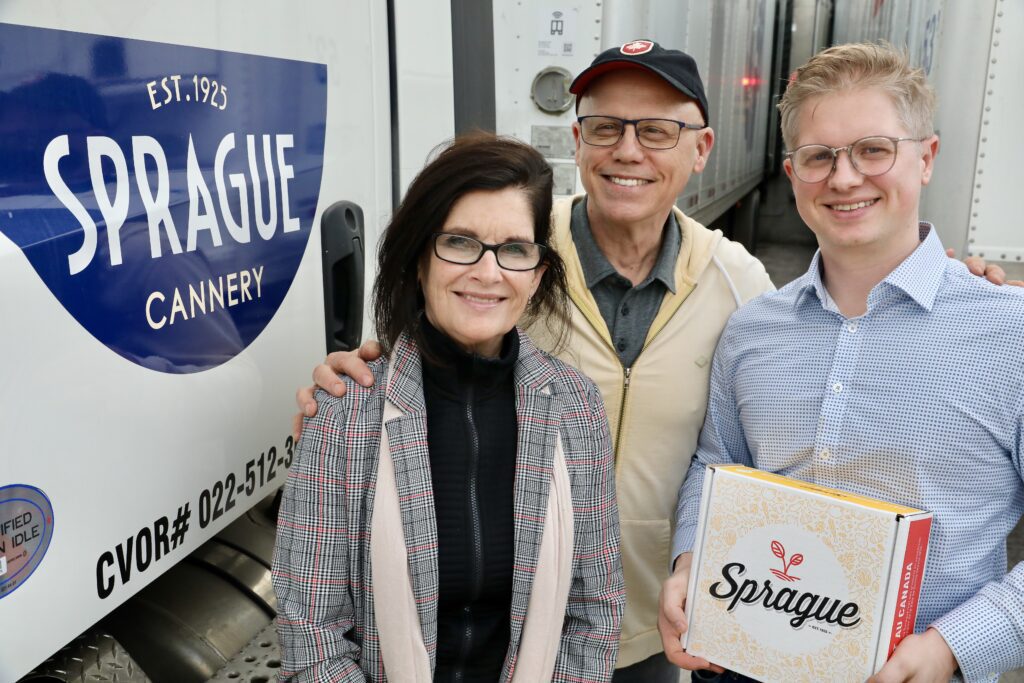
Sixty years later, Rick is still enthusiastically showing up for work every day at the family business – Sprague Cannery, a Belleville company that is the sole survivor of the once thriving canning industry in the area. For him, there is still a magic to the place – and plenty of savoury smells. This year the company is celebrating its 100th anniversary, a business success story that embodies constant challenge overcome by continuous adaption, technological change, market diversification, and sheer stubbornness.

The company began in August 1925. That’s when Rick’s great – grandfather decided to gamble in the canning gold rush in his hometown of Prince Edward County, Ontario. Grant Sprague was already a successful entrepreneur with a farm, grocery store, and telephone company, the area’s first telephone service. But he was always on the lookout for new ventures.

The area’s canning industry was booming in the 1920s. From the 1880s until the 1960s, Prince Edward County was so dominant within the Canadian canning industry, it was known as ‘The Garden County of Canada.” It was a hot, tough business battling the traditional hardships of farming everywhere – drought, frosts, and pests. In the early days, brutal monopolistic contracts from the larger firms left few options for most farmers to sell their crops. But over time, independent companies like Sprague offered an alternative market to farmers and jobs for their families.

Grant Sprague did not stay long with his new canning factory in the hamlet of Mountain View. It wasn’t the hardships. It just didn’t fit his dress code.

“He liked to wear a suit,” says Rick. “And a suit and a canning factory did not jive well. So, his son, Jay, who was my grandfather, took over the very next year. And it was run as a seasonal operation 6-7 weeks a year – mainly as a tomato canner, tomato juice, some pumpkin, raspberries, and some cream corn.  And that ran for many decades.”

But times were changing and becoming more turbulent. Two wars and a depression had artificially kept the local industry going. After the Second World War, the canning business rationalized and moved to southwestern Ontario with its more fertile land and longer growing season. Labour and environmental laws imposed stricter regulations on local firms. New products – like frozen food – were gaining market share at the expense of canned goods. Chain stores wanted canned goods “on demand” forcing companies to build heated storage facilities. The 1960s brought a tsunami wave of profound change. Ultimately, the industry that once meant everything to The County was gone for good, and the days of canned products seemed doomed.

“My grandfather died of a heart attack suddenly in 1967,” Rick remembers. “And then my Dad, [Roger] a 32-year old, was faced with a decision. He knew that a seasonal canning factory of that scale canning six weeks a year, probably didn’t have a long future. So, he looked at a different approach… And he looked to Toronto and Montreal. There were different ethnic communities that were growing and needed their own unique foods. And he identified beans as a great opportunity to can all year round and extend from the tomato season to the next tomato season to keep the plant working. And so, he built a new plant at that point in order to can through the winter and developed some good relationships with ethnic-based companies in Toronto and Montreal, mostly with a couple of key Italian companies, and started canning chickpeas and red kidney, lentils, white kidney and Romano beans and on and on it goes…because he believed there was a future in foods that were better than what was on the market.”

In 1995, the firm built a new processing facility in Belleville. The new plant was an opportunity to introduce new design ideas and technology. The Spragues abandoned traditional factory floor plans in favour of a more open concept that created efficiencies, but was considered so radical, the design plans needed government approvals. They bought new technology from Europe to modernize operations. And when a Campbell’s Soup plant in Ontario closed in 2019, they bought 20 truckloads of equipment. The automated filling and can capping equipment, large, super-heated water retorts to cook and cool canned products and labelling equipment dramatically increased production capacity. Today, the plant can process 350 cans of products every minute. And the company produces around 50 different canned goods from soups to chili to beans exported across Canada and The United States and new markets in Europe and Asia.

“As a little boy, I was so excited to go to work,” says Rick. “And here I am today, and I feel the same excitement. I walk into this place each morning and hear everything, the smells, and the people and what we are doing and the challenges. And I just love it. So, I feel very fortunate… And it’s just not making it to 100 years, but really in our 100 – year history, we are at a much better place than we have ever been with our brand, the types of products we’re producing, and the growth potential. It’s a great feeling.”